Whatever the Mind Can Conceive and Believe: Meaning & Source
Napoleon Hill's quote explained: imagine a clear goal, believe it is possible, and act on a plan. Check the source and try a practical four-question exercise.
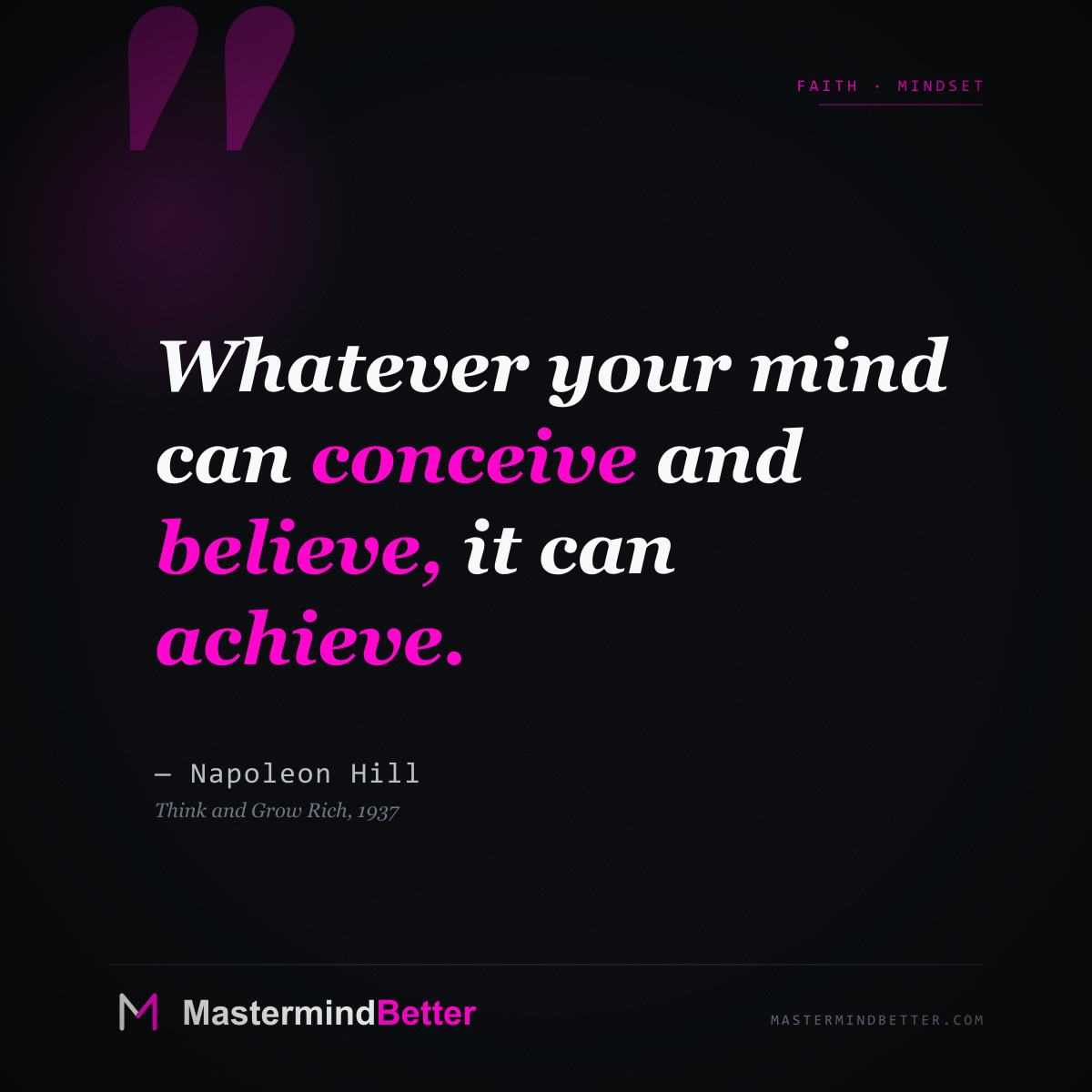
Save or share this quote card
Short answer
Napoleon Hill’s “Whatever the mind can conceive and believe, it can achieve” means that a clear goal and confidence in its possibility can support purposeful action. Conceive is imagining the result; believe is committing to pursue it; achieve is doing the work. It is a motivational principle, not a guarantee that every imagined outcome will happen.
The Napoleon Hill Foundation’s explanation explicitly connects the idea to action and says achievement is not guaranteed. The practical reading here is simple: give your belief a plan, test it against evidence, and revise what is not working.
Quote meaning
| Part of the quote | Put it into practice |
|---|---|
| Conceive | Name a specific outcome, such as holding your first mastermind meeting by the end of the month. |
| Believe | Identify a reason the goal is possible and a constraint you need to solve. |
| Achieve | Take the next step, review what happened, and adjust the plan. |
A vivid idea can get you started. A useful plan makes the idea testable. Other people can help you see the difference between a setback worth working through and evidence that your approach needs to change.
Source and wording
The Napoleon Hill Foundation attributes this idea to Hill and publishes the wording “Whatever the mind of man can conceive and believe, the mind can achieve” in its March 19, 2017 Thought for the Day.
That is a directly checkable source for the attribution and wording. It does not establish the quote’s first publication or a page number in the original Think and Grow Rich. If you need an academic citation, check the specific edition you are citing rather than copying an unsourced chapter or page number.
You will see small wording variations:
| Common version | Notes |
|---|---|
| ”Whatever the mind can conceive and believe, it can achieve.” | The shortest modern quote-card version. |
| ”Whatever the mind of man can conceive and believe, the mind can achieve.” | A common Hill Foundation wording. |
| ”What the mind can conceive and believe, the mind can achieve.” | Another common variant in Hill-related material. |
Those variations do not change the operating point: conception is not enough, belief is not enough, and belief without action is not what Hill was teaching.
What he actually said
Hill spent the whole book setting up the prerequisites: a definite chief aim, organized planning, persistence, the mastermind alliance. Belief isn’t the magic spell. It’s the floor everything else has to stand on. If some part of you doesn’t actually believe the thing is achievable — if a quieter story is already running about why it won’t work — you won’t put in the work that would prove the belief out.
A useful distinction for applying the quote is belief that stays open to evidence. If your goal is to start a group, a low response to the first invitation is information: the timing, audience, or offer may need work. Confidence gives you a reason to investigate; it does not tell you to ignore the response.
What I keep seeing in mastermind rooms
I’ve watched this play out in mastermind groups for almost a decade. The members who actually move forward aren’t the ones who arrive most confident. They’re the ones who arrive with a specific belief about a specific outcome, then keep that belief alive through honest contact with what the work is showing them.
The room helps two ways. First, it stress-tests the belief — five people who care about your work will push on whether your goal is real or just performative. Either you sharpen the conception, or you discover the belief was thinner than you thought. Second, when the belief is real, the room is what keeps it from corroding under setback. The same evidence that would push you out of the work alone becomes data to talk through together.
That’s the part Hill saw in 1937 and the part the modern setup amplifies. We have tools — research, networks, communication systems — that let the implementation scale in ways he couldn’t have imagined. The principle didn’t change. The amplifier did.
How to use the quote without fooling yourself
Use the quote as a four-part test, not a slogan:
- Can I state the thing clearly enough to test?
- Do I have a reason to believe it is possible?
- What plan would make the belief visible in action?
- Who will see the plan, challenge it, and notice when I drift?
The fourth question is where a mastermind group changes the quote. Alone, belief can become private theater. In a room, belief has to survive questions, timelines, and evidence. That does not make it smaller. It makes it sturdier.
A five-minute exercise for your next meeting
Write one sentence for each prompt. This is a practical exercise for using the quote, not a passage from Hill’s book.
- My aim: By [date], I want to [specific result].
- My reason to believe: I have [skill, resource, or evidence] that makes this plausible.
- My next action: This week I will [one observable action].
- My review: On [date], [person or group] will help me assess [evidence of progress].
For example, an aspiring facilitator might aim to hold one pilot meeting, invite three people who share a specific problem, and ask them afterward whether another session would be useful. The response tests the idea before the facilitator invests in a larger program.
Use the free mastermind meeting agenda to bring that goal and its next action into the room. If you want the wider framework first, the free ebook explains the method behind the practice.
Belief vs. delusion
Belief has contact with reality. Delusion avoids contact with reality. That is the practical difference.
A real belief can take feedback, update a plan, and keep moving. A delusion treats feedback as betrayal. In a good mastermind, the room protects you from both cynicism and fantasy. It will not let you abandon a strong aim just because the first attempt failed, and it will not let you hide a weak plan behind inspirational language.
That is why this quote belongs next to strategic planning and accountability, not only next to mindset content.
Where this sits in the method
In the Mastery Method, belief is part of Mindset (Pillar 1). It feeds Planning & Goals because you cannot plan a future you do not think will arrive. It compounds in mastermind alliances because the rooms either reinforce or erode it depending on who is in them.
The quote isn’t a slogan. It’s a precondition. Read it that way and it does real work.
Source notes
- Napoleon Hill Foundation, Conceive, Believe, Achieve, uses the “mind of man” version of the quote.
- Napoleon Hill Foundation, Hill’s Secret, discusses the quote and emphasizes action as the necessary bridge.
- Google Books, Think & Grow Rich, surfaces the phrase in the book preview/description for modern editions.
See also: If you do not conquer self - A goal is a dream with a deadline - What is a mastermind?
Share the idea. Keep the context.
Send the quote card with a link to this interpretation, or save the image for later.