“Small deeds done”: Peter Marshall on turning plans into action
The source of Peter Marshall’s small-deeds quote, why it is not an argument against planning, and a practical way to leave a meeting with one useful commitment.
 Jeff Hopp 2 min read
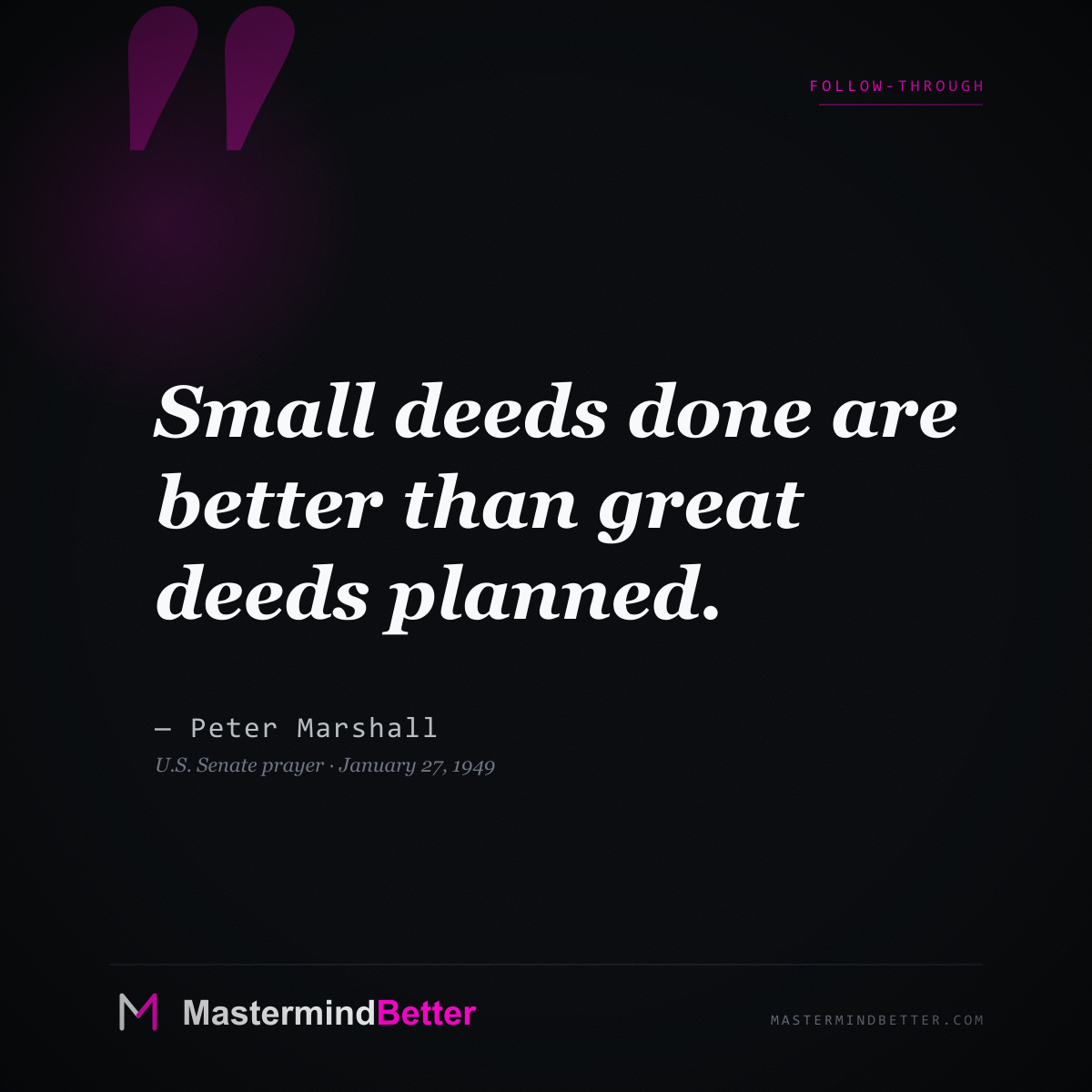
This excerpt comes from a prayer written by Peter Marshall and read to the U.S. Senate by Clarence W. Cranford on January 27, 1949. The Congressional Record identifies both roles. The excerpt begins within a longer sentence; its initial capital is normalized.
Small deeds done are better than great deeds planned.
— Peter Marshall · Read the source
Planning earns its place through action
A plan can expose dependencies, reduce waste and help people work together. Marshall’s line is useful when planning has become a substitute for doing anything at all. The contrast is between a modest completed contribution and an impressive intention that never leaves the conversation.
That does not mean doing the easiest task merely to feel busy. The useful small deed has a relationship to the larger purpose. Sending one well-considered question to the right person may move a project further than reorganizing a hundred notes.
Turn a broad intention into a commitment
Consider a hypothetical group member who says, “I need to improve my offer.” That may be true, but it does not tell anyone what will happen next. A more useful commitment is: “Before Tuesday, I will ask one existing customer which part of the offer was hardest to understand, with their permission, and bring the answer back.”
The smaller commitment has four parts:
- An action: what will actually be done.
- An owner: who has agreed to do it.
- A review point: when the group will look at the result.
- A learning question: what the action could help clarify.
The group should help make the commitment realistic. Assigning work to someone who has not agreed is not accountability; it is an assumption.
Review the result without turning it into a trial
At the next meeting, ask what happened. If the action was completed, discuss what it revealed and whether the larger plan should change. If it was not, find the obstacle: unclear scope, a dependency, competing demands or a decision that was never truly made.
A repeated obstacle may justify changing the plan. It does not automatically justify harsher pressure. The point of a small commitment is to make learning possible while the cost of being wrong is manageable.
A useful closing question
Ask each member: “What can you finish before we meet again, and what help would make it possible?” Leave enough time for an honest answer. One realistic commitment is more useful than a list everyone already knows they cannot complete.
The free meeting agenda gives decisions and next actions a place in the session. If you need the wider framework, the Mastermind Better ebook connects planning, facilitation and follow-through.
Share the idea. Keep the context.
Send the quote card with a link to this interpretation, or save the image for later.