“Injustice anywhere”: Martin Luther King Jr. on shared responsibility
Read King’s words in their 1959 freedom-struggle context, then consider a careful question for collective decisions: who is affected but absent from the room?
 Jeff Hopp 2 min read
The King Institute records this sentence in King’s May 13, 1959 remarks at the Africa Freedom Dinner at Atlanta University. This page cites that speech rather than assuming every appearance of the line comes from the same document.
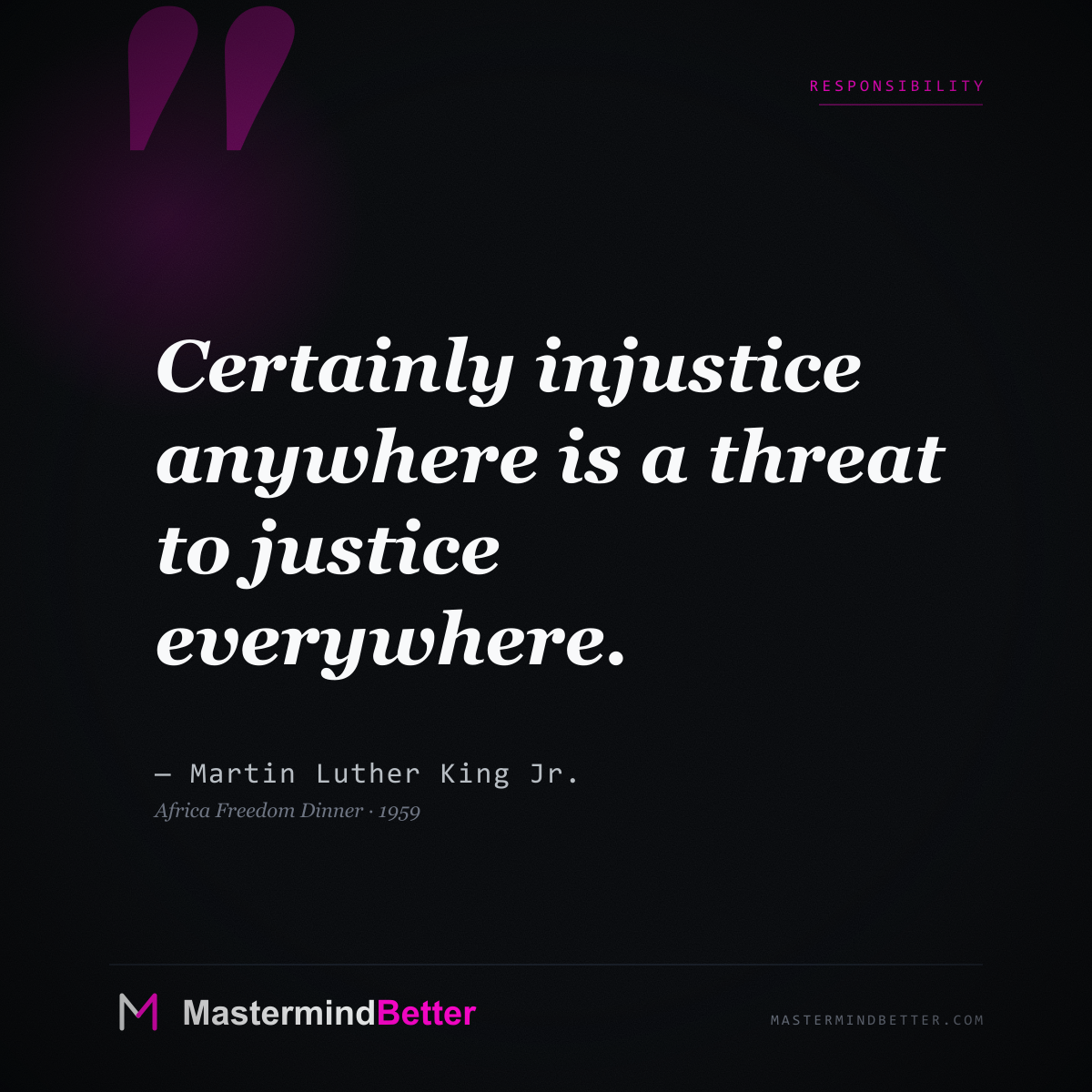
Certainly injustice anywhere is a threat to justice everywhere.
— Martin Luther King Jr. · Read the source
Keep the freedom-struggle context
King delivered these remarks at an Africa Freedom Dinner in Atlanta before an address by Kenyan nationalist leader Tom Mboya. He connected the struggle against racial injustice in the United States with struggles for freedom elsewhere. The source is a transcript drawn from an audio recording of the event.
This is not a statement about making a team more productive. It concerns human dignity, freedom and responsibility beyond one’s immediate surroundings. Quoting it responsibly means keeping that substance visible rather than using it as a decorative success slogan.
A careful application to collective decisions
A group pursuing a shared goal can become absorbed in the interests of its members. That focus may help people cooperate, but it can also leave the consequences for others unexamined. A decision can benefit the people in the room while creating costs for people who were never invited into it.
One useful question is: who is affected by this decision but missing from the conversation? This is an application for present-day group practice, not a claim that King was teaching a business facilitation method.
Look beyond who attends
Suppose a community group is choosing a meeting location. Everyone present may find the venue convenient. That does not establish whether someone absent could access it, afford the journey or attend at that time. The group needs to ask rather than treat its own experience as complete.
The same habit applies to how decisions are made. Does someone have a practical way to raise a concern? Can they disagree without being dismissed? Has the group explained what can change and what is already fixed?
Listening does not guarantee agreement. It does give a decision a better chance of accounting for the people who will live with it.
A question to put on the agenda
Before a consequential decision, record:
- Who is likely to benefit.
- Who may bear a cost or face a barrier.
- Whose perspective is missing.
- How you will seek that perspective before proceeding.
Do not appoint one person to speak for everyone who shares an identity or circumstance. Where possible, make room for people to describe their own needs. Be clear about the limits of what your group can decide.
The facilitation resources can help structure a conversation. The ethical work remains yours: deciding what you owe to people beyond the immediate group and acting on what you learn.
Share the idea. Keep the context.
Send the quote card with a link to this interpretation, or save the image for later.