Most great people have achieved their greatest success one step beyond their greatest failure.
Hill on the asymmetric cost of stopping too early. The greatest success is one step past the greatest failure — but the trick is knowing when you're one step away.
Save or share this quote card
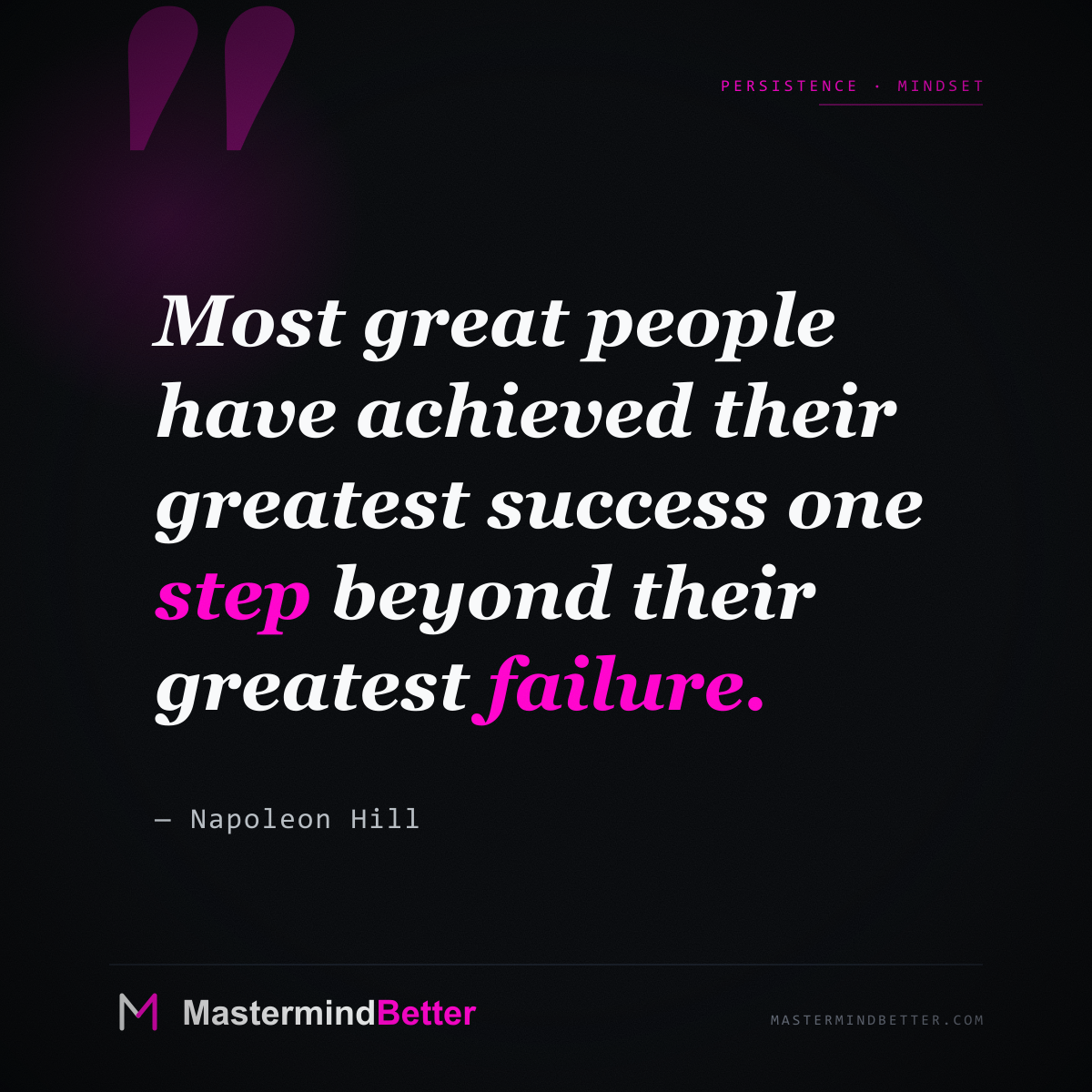
There’s a survivorship-bias version of this where it just means “keep going until you succeed.” That reading misses what Hill is actually pointing at.
The geometry of the claim
Hill is making a specific structural claim: the failure and the success are not separate events. They’re consecutive steps in the same sequence. The thing that produced the success was the persistence past the moment when the failure looked terminal.
The cynic’s pushback writes itself: yes, but plenty of people kept going one step past their greatest failure and just had a greater failure. Hill knows. He isn’t saying persistence guarantees success. He’s saying success is generally found at the far edge of persistence, not the near edge. Most people don’t get there because they stop too early. The geometry is asymmetric — the cost of giving up too soon is much higher than the cost of one more attempt.
What I keep seeing in mastermind rooms
The most interesting thing about this pattern is how clearly it shows up in retrospect and how invisible it is in the moment. The member who just shipped the thing that worked usually had at least two prior versions that didn’t. The third try worked because the first two taught them what the problem actually was.
When someone in the room is in the middle of a failure that feels terminal, the room’s job is to ask the right question: is this failure done teaching you yet, or are there one or two more iterations of information still available? Sometimes the honest answer is “done, move on.” More often the answer is “no, one more pass.”
Where this sits in the method
This is Persistence — woven through Mindset (Pillar 1) and Planning (Pillar 2). It’s also, importantly, why the mastermind room matters. Persistence past failure is hard to summon alone. It’s much more available with a room that can tell you whether you’re being persistent or being stubborn.
The greatest success is one step beyond the greatest failure. The trick is knowing when you’re one step away.
See also: Victory is always possible · Every adversity carries a seed · Don’t wait, the time will never be just right
Share the idea. Keep the context.
Send the quote card with a link to this interpretation, or save the image for later.