How a Mastermind Meeting Actually Runs
A 90-minute, biweekly cadence. The agenda, the protocol, what the facilitator actually does, and the four ways meetings fail.

The first time someone plans or joins a mastermind, they ask the same question: how does this actually run?
It’s a fair question. The word “mastermind” gets used so loosely — a coaching program calls itself a mastermind, a paid group chat calls itself a mastermind, a peer support call calls itself a mastermind — that “what’s the format” stops being obvious. This is the practical default behind Mastermind Better’s meeting guidance, with the rationale for each choice and the four ways the format tends to fail when it does.
If you’re considering a group, use this to understand the commitment. If you’re already running one, take what’s useful and leave the rest — there’s no one true mastermind structure, but there are structures that hold up under load, and this is one.
This page is the deep facilitator protocol for one 90-minute format. If you are still choosing a meeting length, start with the copy-ready mastermind agenda options for 60-, 75-, 90-, and 120-minute meetings.
The frame: 90 minutes, every two weeks
A strong default is 90 minutes every two weeks. Five to seven members. Same room, same cadence, same facilitator.
Each of those numbers is a design choice with a reason.
90 minutes is the longest most adults can sustain real attention in a video meeting without the quality decaying. Shorter than 60 and you can’t run the hot seat properly. Longer than 100 and you start losing the late-meeting members to fatigue. 90 is the corner case where everything fits and nobody’s eyes are glazing over by the end.
Every two weeks is the cadence that keeps continuity without becoming overhead. Weekly is too frequent — most members can’t generate enough action between meetings to make the next session meaningful. Monthly is too sparse — the thread breaks, members forget what they committed to, the group never builds shared context. Every other week is the rhythm that lets commitments be tested before they’re forgotten.
Five to seven members is the smallest group that still teaches and the largest group that still hears every voice. Smaller and the pattern diversity collapses — you stop encountering problems you’d never run into alone. Larger and the format becomes a panel; the people who don’t speak first stop speaking at all.
Same facilitator matters because the facilitator’s job is partly cumulative — they’re learning each member’s situation, their tendencies, their commitments. A rotating facilitator never gets there.
The block-by-block agenda
The 90 minutes break into five blocks. None of them are negotiable.
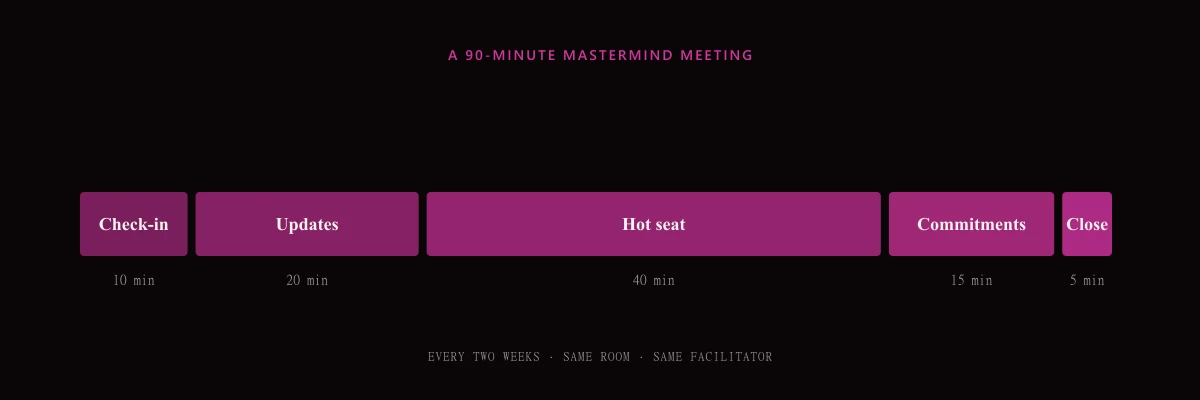
Check-in — 10 minutes. Each member, in turn, names where they are coming into the meeting in one or two sentences. Not a status update — a state report. “I’m coming off a hard week, low energy, will probably listen more than speak.” “I’m wired about the launch tomorrow and might be scattered.” This block exists because everything that follows depends on knowing what kind of room you’re in. Without it, the hot seat gets advice calibrated to an imaginary average member; with it, the advice gets calibrated to a real one.
Updates — 20 minutes. Each member, in 3-4 minutes, says what they committed to at the last session and whether they did it. No advice during this block. No discussion. Just the report. The facilitator may ask a clarifying question — “is the launch on track or did the date slip?” — but the conversation doesn’t open up. The point of this block is accountability, not problem-solving. The accountability is in saying out loud, in front of people who remember what you said last time, whether you followed through.
Hot seat — 40 minutes. One member takes the room. They name a specific problem or decision they’re working on — usually one that’s been on their mind for the previous two weeks. The other members spend the time helping them think about it. The facilitator’s job is to make the room productive: cutting tangents, redirecting advice that’s really storytelling-about-the-advisor, making sure the member in the hot seat is actually getting what they need rather than what the room finds easiest to give. This is the block that makes the meeting a mastermind instead of a peer hangout.
Commitments — 15 minutes. Each member, in turn, names one specific thing they will have done by the next session. Not “I’ll work on the proposal” — “I’ll send the proposal to the three named clients by Friday.” The facilitator pushes for specificity. The point is to make next session’s update block possible.
Close — 5 minutes. A short ritual to mark the end. Could be a single sentence each — what you’re taking away. Could be a shared silence. The specific format matters less than having one; the close turns the meeting into a unit rather than a slow fade.
What the facilitator actually does (and doesn’t)
A facilitator is not a teacher. They’re not the most experienced person in the room. They’re not the one with the answers.
What they do:
- Hold time. They watch the clock. They cut blocks at their boundaries even when the energy is good. They protect the hot seat from being eaten by a long updates block.
- Hold the protocol. When the group drifts — into peer hangout, into advice-instead-of-questions, into the loudest member dominating — they reset.
- Hold attention to the member in the hot seat. They notice when advice is wandering away from what the member actually needs. They redirect.
- Hold silence when it’s productive. A pause where someone is thinking is not a problem to solve.
- Hold a low profile in their own contributions. They speak when they need to. They don’t fill space.
What they don’t do:
- Solve the problem in the hot seat for the member. Their job is to make the room productive, not to be the room’s brain.
- Become the smartest voice. A facilitator who turns every problem into a chance to share their own story is sucking the room’s surface area into themselves.
- Skip the protocol because the conversation is good. “Good conversation” without structure decays into the same five voices having the same five favorite topics. The protocol is what keeps the meeting useful at month 18, not just month 2.
Good facilitation looks almost invisible from inside the group. The members feel like the room is working well. The facilitator’s craft is what made it feel that way.
The hot-seat protocol
The hot seat is the heart of the format. Here’s how it actually runs.
The member with the hot seat opens with the problem in one minute or less. Not the backstory — the problem. “I’m trying to decide whether to take the partnership offer from Company X. I have a draft answer leaning yes. I want pressure-testing.” Specific. Bounded. Falsifiable in the sense that there’s a clear thing to react to.
The other members then have 5–10 minutes of clarifying questions only. No advice yet. Just questions that surface the actual shape of the problem. “What are you afraid of if you say yes?” “What’s the no version look like?” “Have you talked to anyone else who took a deal like this from them?” The hot-seat member answers as honestly as they can.
Then comes the working block — 20–25 minutes of structured response. The facilitator usually frames it: “Let’s go around the room — what would you do if this were your decision, and what specifically would make you reconsider?” Members respond in turn. The hot-seat member listens, takes notes, doesn’t argue. Pushback comes later.
The last 5 minutes are the hot-seat member’s. They say back what they heard, what landed, what they’re going to do — or not do — between now and next session. The commitments block later will pin it down formally.
The protocol works because it separates understanding the problem from proposing solutions from integrating the response. Most casual peer advice collapses those three into one, and the result is six people talking past each other while the person with the problem tries to extract a usable thought from the mess. The protocol slows it down enough that something useful comes out.
The four ways meetings fail
The format is robust, but it can fail. Four common modes:
1. The peer-hangout drift. Over months, the group gets comfortable. Updates become rambling. The hot seat becomes a sympathetic listen. The commitments become vague. Nothing is wrong, except that the structural pressure that made the meetings useful has quietly dissolved. The corrective is for the facilitator to name it out loud — “we’ve been drifting; let’s get back to the protocol next session” — and then actually hold the structure when next session arrives.
2. The dominant member. One member talks more than their share, every meeting. They mean well. They have a lot of experience. The room defers. Over time, less-loud members participate less. The format quietly converts into one person being heard by five others. The corrective is unsubtle: the facilitator names it privately with the dominant member, and structurally limits speaking time in the next few sessions until the room balances back.
3. The unprepared hot seat. A member arrives without having actually worked on what they want to bring. They use the hot seat to think out loud for the first time, which means the room is doing the member’s pre-work for them — and the response they get is calibrated to a fuzzy problem rather than a clear one. The corrective is upstream: a one-sentence pre-meeting prompt that nudges the hot-seat member to write down their problem before they show up.
4. The format-as-ritual collapse. The group runs the protocol the way some people run gym programs: the steps happen, the form is correct, but the intensity is gone. Updates are bland. Hot seats are safe. Commitments are easy. No one is putting anything at risk. The corrective is for the facilitator to ask, sometime in the close, “is anyone willing to put something hard into next session’s hot seat?” — and let the silence sit until someone takes it. Discomfort, by design.
What this format isn’t
This isn’t the only mastermind format that works. It’s a default shaped by years of running and studying groups. Other formats — different time blocks, different cadences, different group sizes — work too. What they all share, the ones that work over years, is some version of: small group, real cadence, structured pressure, accountable commitments, an external person whose job is to hold the structure.
Mastermind Better publishes this format as guidance; it does not currently place readers into a standing group. If you’re running a group, you might find one or two of these design choices worth borrowing. And if you’re trying to decide whether the format is for you at all, it is most useful when you have something you’re actively working on and want a small room of people doing real work to think alongside you.
If you’re piecing this protocol together meeting by meeting, the Operator Kit has the 40-minute hot-seat protocol, facilitator interventions, and the commitment loop built out.
Design the rest of the group → Or read the rest of the Mastery Method →.